News
Expedition 2 Summary Report Now Available
Thursday, 16 December 2004
A report authored by Jonathan Clarke, Rocky Persaud and Shannon Rupert-Robles summarising the results of Expedition 2 is now available online here (pdf format). You can read more about the expedition at the Expedition 2 Homepage
Construction Continues
Friday, 8 October 2004
Construction is proceeding smoothly, with a number of basic components being fitted, including the new forward and rear propeller shafts, the primary fuel tank and shock absorbers. With the steel framework of the floor (almost) complete, we are ready to begin assembling the floor 'sandwich', which consists of an aluminum sheet panel (underside), thermal insulation layer (glass fibre bats and hardwood standoffs) and a plastic and aluminum upper layer. Vertical bulkhead frames can be fabricated as soon as a new order of RHS steel arrives. More component shopping is required, including better seats, an extra fuel tank, and plumbing for the coolant system.
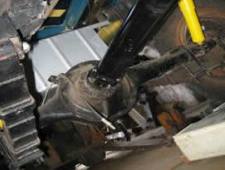
Underside of vehicle showing propshaft (black), primary fuel tank (silver) and and rear shocks (yellow).
|
... |
AMEC2004 a Success, Expedition 2 Completed
Monday, 6 September 2004
 The 4th annual Australian Mars Exploration Conference was successfully held in Adelaide over the weekend of Saturday 31st July and Sunday 1 August. Hosted by the School of Natural and Built Environments at the University of South Australia, the conference featured local and international speakers presenting papers in a diverse range of Mars related disciplines. For information about the program, visit the AMEC 2004 page.
Expedition 2, a joint research expedition between the Mars Society Australia, has now been completed.
Engine Now Mounted
Friday, 6 August 2004
Further construction work is continuing, slowly. The engine mounting and steel framework is basically complete and work is now proceeding to propeller shafts, steering link and frame for the radiator. The gearshift and transfer box linkages are proving to be particularly challenging, since a set of two complex controls need to be brought forward over the cabin from the behind the engine. Mechanical engineer Andrew Cornejo has agreed to design these, based on conceptual sketches from Bruce Armstrong.

Busy day deciding on the placement of seats, and arguing about control linkages
|

Basic sketch of gearbox modification for forward controls, which will use Bowden cables... |
Steelwork Plans Complete
Friday, 7 May 2004
It's taken a long time to get further with the project, since both of the main workers have been tied up with other duties (read: paid work). However, at last the steelwork plans were completed and the floor frame and vertical bulkheads are being assembled. Now that this work is in hand, the task for we MSA volunteers is to get busy with the support equipment for the powerplant: exhaust system, coolant plumbing, electrical and transmission.
Trinity College 'Spaced Out' By New Mars Research Laboratory
Friday, 16 April 2004
An initiative between Trinity College in East Perth and Mars Society Australia, will see an innovative new Centre for Planetary and Space Studies set up at the East Perth school this year, bringing Mars research to the heart of the Western Australian capital. Mars Society Australia’s Vice-President and Outreach Director, Mr David Cooper, believes that this Centre may well be the first space research laboratory to be established in a secondary education institution in Australia, and speaks enthusiastically about the goals of the new Centre.
Read the full media release.
Also check out the centre's new webpage and download an information leaflet, which includes a program of upcoming events.
Read the full media release.
Also check out the centre's new webpage and download an information leaflet, which includes a program of upcoming events.
NASA Rover Opportunity Lands on Mars
Sunday, 25 January 2004
NASA's second robotic rover lander Opportunity has safely landed on the surface of Mars at Meridiani Planum. Read the latest news as it unfolds at NASA's Mars Exploration Rover Mission Homepage.
Call for Australian Involvement in New U.S. Space Program
Thursday, 15 January 2004
In a speech to NASA Headquarters in Washington D.C., U.S. President George W. Bush has announced an inspiring new course for human space exploration through the 21st century. As he notes, in the past 30 years, human beings have not set foot on any other world, nor ventured farther upward into space than 386 miles. This is about to change. Mars Society Australia applauds this bold vision and calls on the Australian Government to do what it can to support the United States in achieving this ambitious goal, which has enormous ramifications for mankind.
Read the full media release here
Read the full media release here
Powerplant Gets Serviced
Thursday, 15 January 2004
Much work on the powerplant - a modified 3 litre, diesel engine with 4 x 4 transmission - took place slowly over the past few months. Many components, especially seals, gaskets, clamps and water pipes etc. of the engine were cleaned, inspected, painted and/or replaced. The oil pan was removed, cleaned and painted. A modified oil dump line was fitted and the speedometer cable was removed. The handbrake was dismantled, inspected for wear, tested and replaced. The speedometer cable was removed - it will be replaced with an electronic version. A new triple pulley is to carry a second, 100W alternator and a small airconditioner compressor. Design of the mountings for these devices has been deferred until the powerplant is mounted in the vehicle chassis to ensure a good fit. The powerplant then was transported to the Byfield factory in a special carrier (see below, left). There the unit was positioned in the chassis (below, right) and a plan of which mounting brackets to add, remove or...
NASA Rover Spirit Lands on Mars
Sunday, 4 January 2004
 NASA's Deep Space Network has received its first images from the Mars Exploration Rover Spirit, shortly after it descended to the surface at around 3.35pm Eastern Australian time. Once deployed, it is planned that the rover will undertake a 90 day mission of scientific investigations around the landing site in Gusev Crater. Australia will be contributing to the mission by providing communications through the Deep Space Network's Canberra facility.
 Read the latest news as it unfolds at NASA's Mars Exploration Rover Mission Homepage.